Ӿ402Nano: a Feeless x402 Facilitator for AI Agent Payments
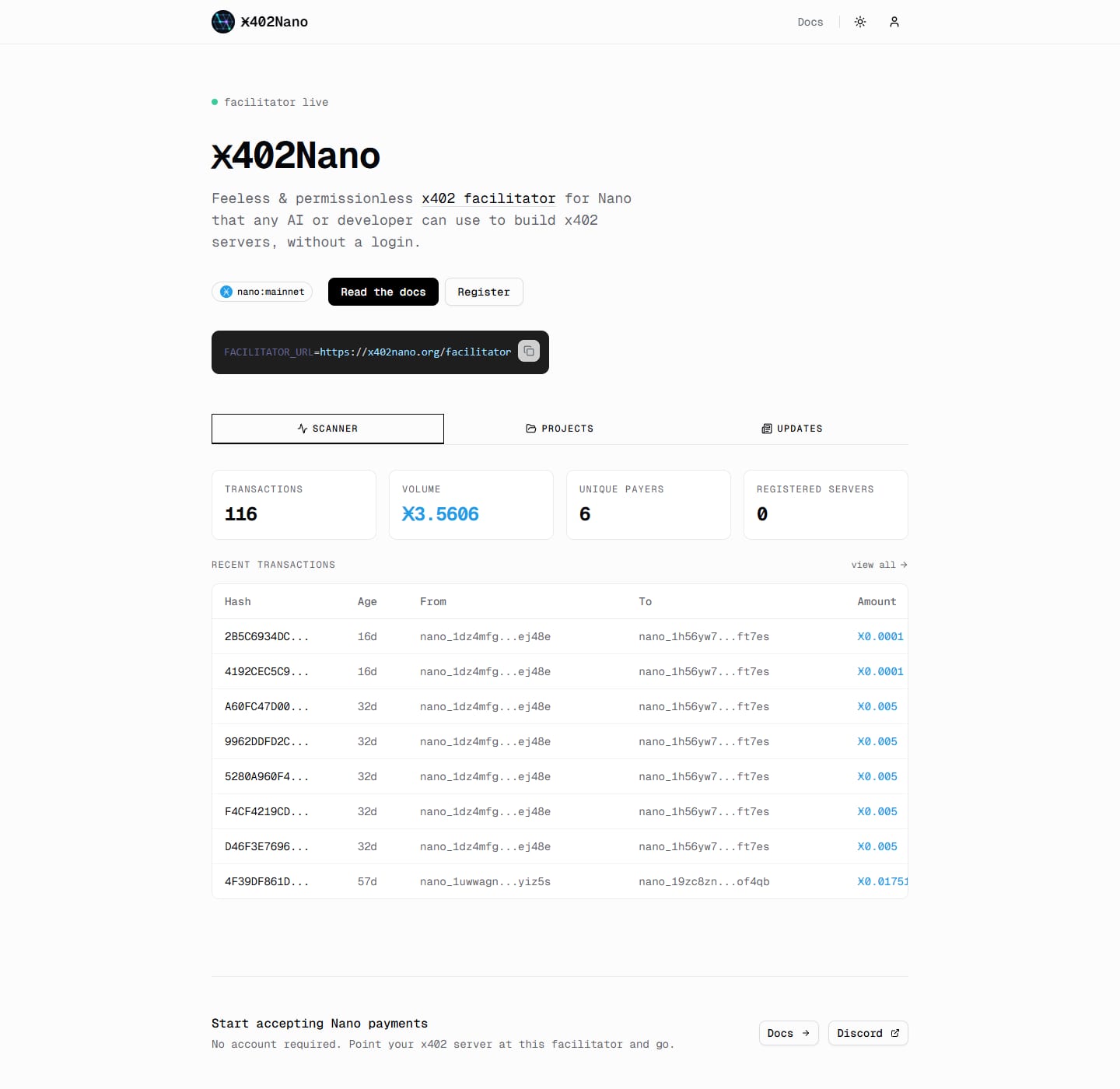
Nano now has a feeless door into x402, the HTTP payment protocol built for AI agents. Ӿ402Nano is a facilitator for Nano: any x402-compatible resource server can point at https://x402nano.org/facilitator and start accepting XNO, with no account, no API key, no setup beyond a config line. A banner on the homepage confirms it: "facilitator live".
What x402 is
402 Payment Required is a real HTTP status code, defined in the spec but rarely used. x402 gives it a job. A protected endpoint answers an unpaid request with 402 and a Base64-encoded PAYMENT-REQUIRED header stating the terms: accepted scheme, network, price, recipient address. The client signs a payment and retries with a PAYMENT-SIGNATURE header; the server verifies, settles, and serves the content.
The protocol is chain-agnostic, and now stewarded by the x402 Foundation, whose operational launch the Linux Foundation announced. This facilitator implements the Nano side.
Why the fit works
x402 targets machine-to-machine micro-payments: an AI agent paying per API call, per inference. Those amounts are tiny, which is where fees hurt most. On fee-bearing rails a fraction-of-a-cent payment is eaten before it lands; on Nano it settles in under a second, fee-free.
The live table shows that shape exactly: rows of Ӿ0.0001 and Ӿ0.005, micropayments a fee-based network could not carry economically. The numbers behind it, at the time of writing:
Transactions
116
Volume
Ӿ3.5606
Unique payers
6
One honest note before the hype detector goes off: the volume is dominated by repeated small payments between the same two addresses, which looks like testing. Six unique payers is not adoption, it is early proof the plumbing works. The scanner shows the full history, each transaction linking to its block on nanexplorer.
How a payment flows
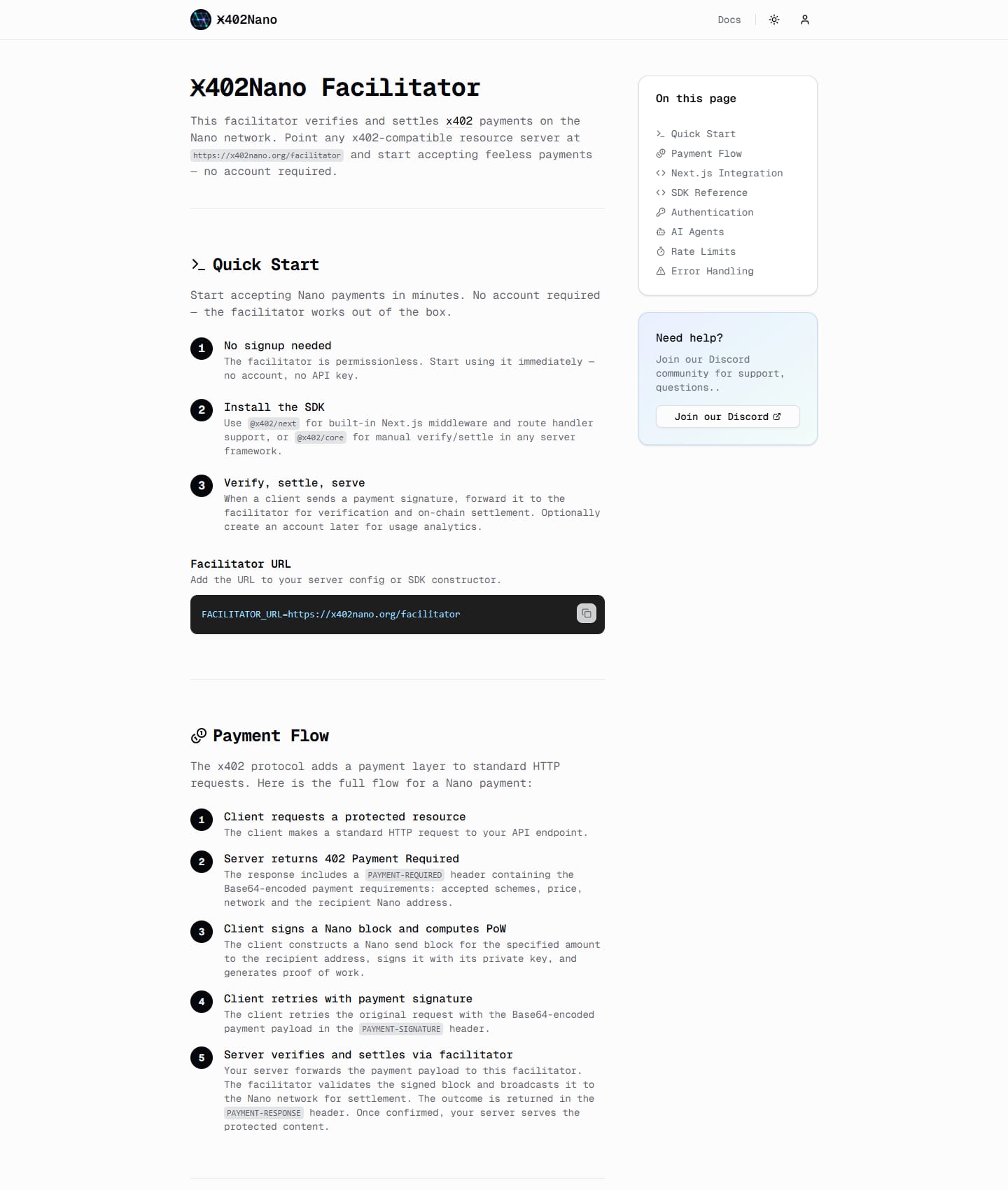
The docs lay out the flow in five steps:
- A client requests a protected resource.
- The server answers 402, with
PAYMENT-REQUIREDcarrying the accepted schemes, price, network, and recipient Nano address. - The client builds a Nano send block, signs it, and generates proof of work.
- The client retries with the Base64 payment payload in
PAYMENT-SIGNATURE. - Your server forwards the payload to the facilitator, which validates the block signature and broadcasts it to the Nano network. The outcome comes back in
PAYMENT-RESPONSE; once confirmed, the server serves the content.
Settle only on success
One design detail matters for machines: settlement only happens after a successful response, so clients are never charged for failed requests. Agents retry constantly; this is what separates a trustworthy protocol from one that bills dead ends.
No account, no API key
Permissionless is the operative word. No signup, no key, no dashboard: point your server at the URL and go. An optional x-api-key or Bearer header only turns on usage analytics in a dashboard. Errors come back in a consistent JSON shape (400 invalid body, 401 bad key, 429 rate limit, 500 server error), and rate limits sit at 200 requests per minute per IP for /facilitator/verify and /facilitator/settle.
The developer angle
Two SDKs cover integration. @x402/next gives Next.js developers paymentProxy (middleware that protects page routes) and withX402 (wraps API route handlers). @x402/core exposes HTTPFacilitatorClient with manual verify/settle for Express, Hono, or any framework. Both point at the same URL:
FACILITATOR_URL=https://x402nano.org/facilitator
Early days, honest read
The AI agent section of the docs is the part that makes this interesting. An agent can autonomously discover a protected endpoint, read the payment requirements, sign a Nano block, compute proof of work, and retry: no human, no account, no card. That is exactly the workflow Nano was built for.
So Ӿ402Nano is a promising piece of the AI-payment puzzle for Nano, nothing more yet. The rails are live at x402nano.org, the docs at /docs, the protocol documented at x402.org. Whether the first real servers register is the number to watch.